


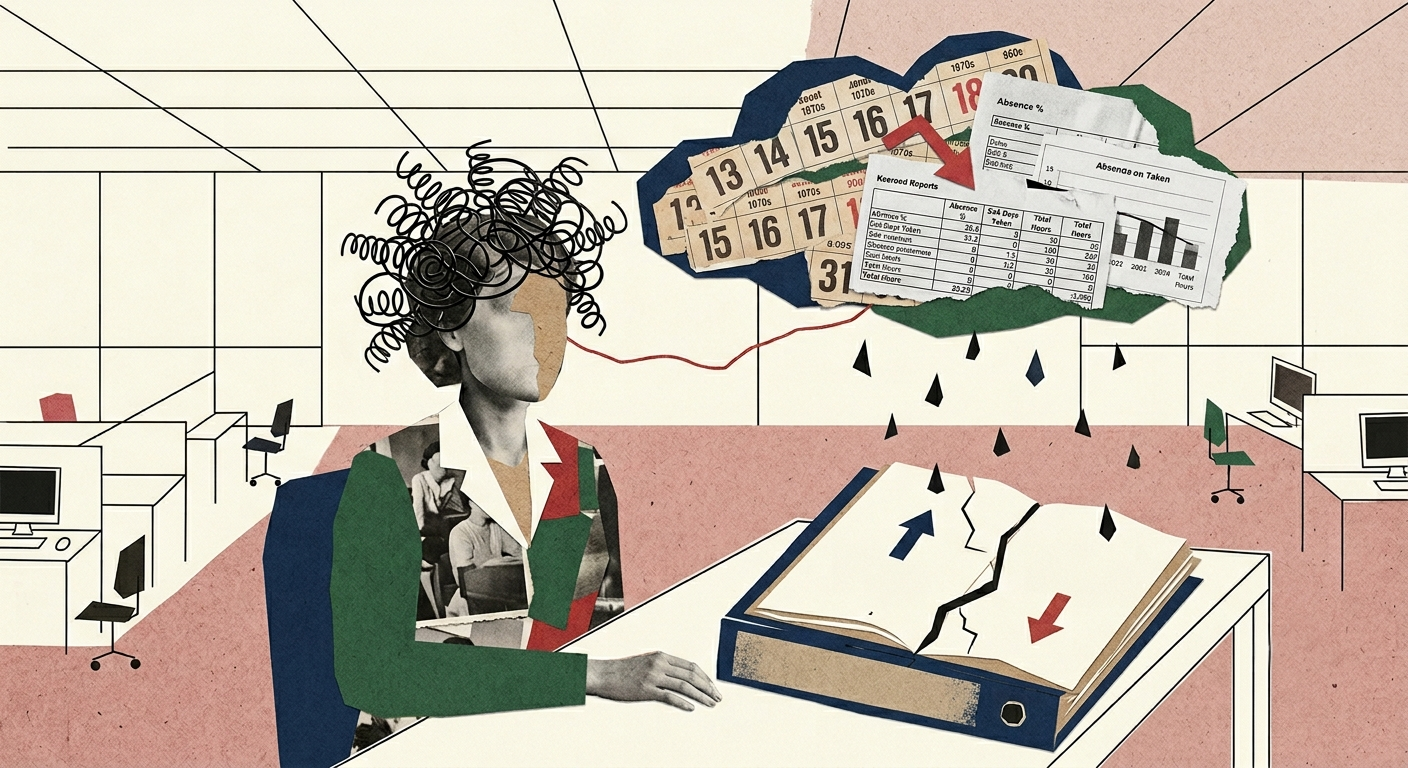
Most organizations track sick leave the way they track office supplies: a number that goes up or down, gets reported to someone in a spreadsheet, and occasionally triggers a policy reminder when it climbs too high. But sick leave data, read correctly, is one of the richest behavioral signals an organization has about the health of its workplace. Read incorrectly, it becomes a metric that gets “managed” into invisibility while the underlying problems quietly get worse.
This is the first in a three-part series on absence data as an occupational health and safety tool. In this post we look at what absence patterns can tell us about job satisfaction, and why the relationship is messier than it first appears.
Part 1 of 3 — Sick leaves as job satisfaction measure (this article)
Part 2 of 3 — How Occupational Health Care Services Monitor Sick Leave in Finland
Part 3 of 3 — Design an Absence Monitoring System
Sick Leave as a Window into Job Satisfaction
The idea that absence reflects something about how people feel about their jobs isn’t new. Classic withdrawal models in organizational psychology place absenteeism on a spectrum of responses to dissatisfaction, alongside lateness, reduced effort, and eventually resignation. When people are unhappy at work but aren’t ready to quit, the theory goes, small unplanned absences are often the first visible crack.
Research broadly supports a moderate link between low job satisfaction and higher absence frequency. But “moderate” is the key word. On an individual level, sick leave is dominated by noise: genuine illness, caregiving demands, seasonal infections, and plain bad luck all show up in the same column as anything related to the workplace. A single absence tells us almost nothing.
What becomes informative is the pattern at a group level. If one department consistently runs a higher absence rate than comparable departments doing similar work, or if a team’s absence rate climbs steadily after a change in management, that’s a far stronger signal than any individual record could provide.
There’s also a counterintuitive twist: very low absence isn’t automatically a sign of a healthy workplace. In cultures where taking sick leave is stigmatized, or where job security feels precarious, people show up while unwell rather than risk being seen as unreliable. This is presenteeism, and it often coexists with, or even masks, the same underlying problems that drive absence elsewhere. A workplace with near-zero sick leave and a workplace with genuinely high wellbeing are not necessarily the same thing.

What This Means for Occupational Health and Safety
From an occupational safety perspective, rising or persistently elevated sick leave often functions as a lagging indicator of psychosocial risk, the kind of risk that, ideally, should have been identified earlier through proactive assessment rather than discovered after the fact in absence statistics.
Two well-established frameworks explain much of this pathway. The job demand-control model points to the combination of high demands and low autonomy as a driver of chronic stress. The effort-reward imbalance model points to situations where people invest significant effort – long hours, emotional labor, high responsibility without commensurate reward in pay, recognition, or security. Both patterns are consistently linked to higher rates of stress-related absence, burnout, anxiety, and depression.
The practical shift this implies is treating excessive workload, unclear roles, poor management practices, lack of social support, and exposure to bullying or harassment as workplace hazards, in the same sense as a noisy machine or a poorly designed workstation. In many European countries, especially the Nordics, psychosocial risk assessment is increasingly a formal part of occupational health and safety obligations.
It’s also worth noting that mental and physical health aren’t as separable in the data as the labels suggest. Chronic stress shows up physically too – disrupted sleep, cardiovascular strain, tension-related musculoskeletal pain. A spreadsheet that neatly divides absences into “mental health” and “physical health” categories is often drawing a line that doesn’t exist in the underlying biology.
On the physical side, sick leave can also surface ergonomic and task-design problems. Repeated short absences clustering around a particular role or workstation are often more diagnostic than a single long absence, since they tend to point to an ongoing exposure rather than a one-off event.
The Risks for Employers
The costs and risks here extend well beyond the obvious line item of sick pay.
Financial risk is dominated less by the direct cost of absence and more by its indirect costs: lost productivity, disrupted teams, rushed cover arrangements, and, critically, presenteeism. Several studies suggest that people working at reduced capacity while unwell costs organizations more in aggregate than the absences themselves.
Sick leave costs Finland five billion euros a year – “Preventing absences is tough economic policy.” In Finland, approximately 25 million working days are lost annually due to sick leave. A recent study estimates that this corresponds to a loss of work input of about five billion euros per year.
Legal and regulatory risk arises because most jurisdictions place a duty of care on employers to identify and address both physical and psychosocial hazards. If absence data reveals a pattern that a reasonable employer should have investigated (a team with a persistent stress-related absence problem, for instance) failure to act can become relevant in disability discrimination claims, workers’ compensation disputes, or regulatory inspections. In Finland, this is built directly into the system: employers are required to arrange occupational health services that include monitoring work ability and supporting early intervention, which ties absence data into a statutory framework rather than leaving it as an internal HR metric.
Retention risk is also significant. Absence is one of the better predictors of eventual resignation, so elevated sick leave often precedes and compounds the cost of replacing staff.
Reputational risk rounds this out. As workplace mental health receives more public attention, organizations known for high sickness rates or a culture of presenteeism may find it harder to recruit and retain talent.
In Part 2 of this series, we look at how occupational health care services in Finland actively monitor sick leave patterns — and what happens when they spot something worth investigating.